
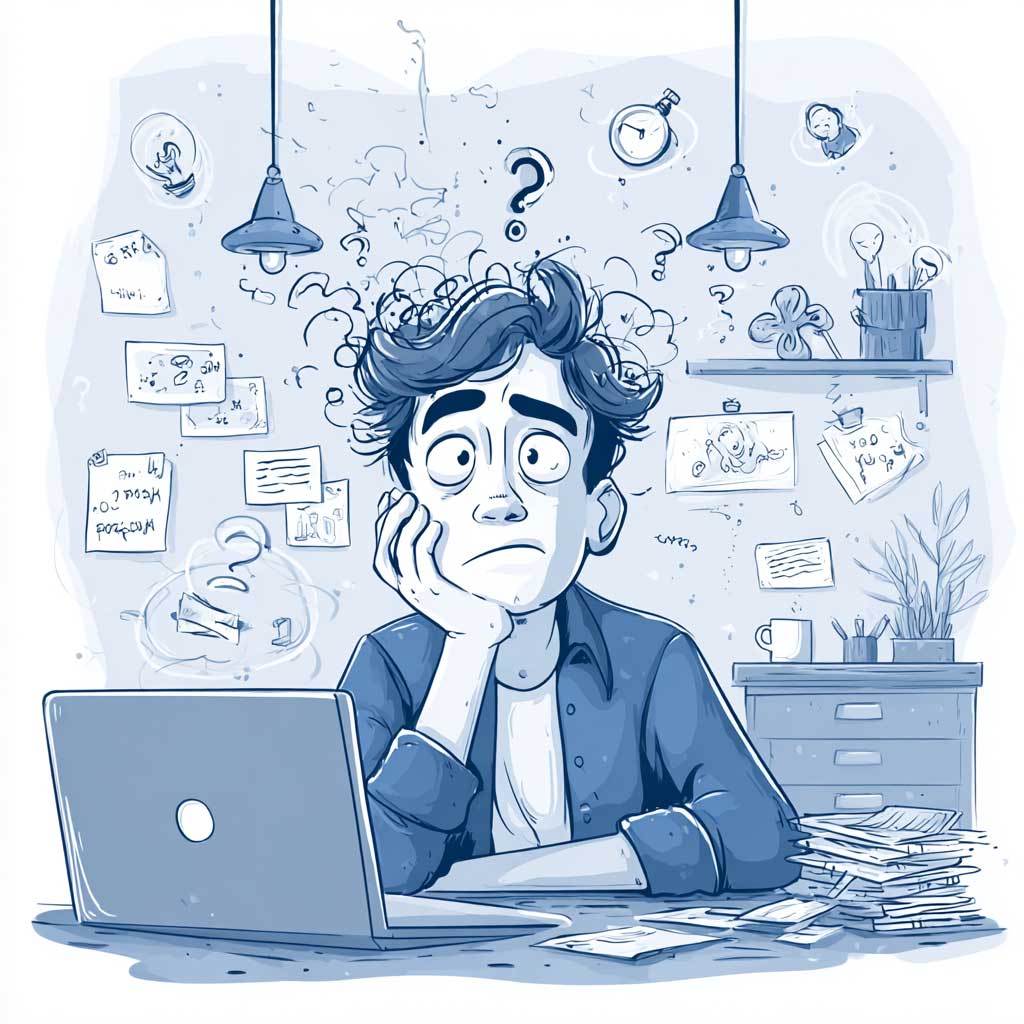
Let’s start with some reassurance:
Your website is probably not broken.
It’s just… not psychic.
I can’t tell you how often I hear variations of the same concern:
-
“My site launched last week and nothing’s happening.”
-
“Why isn’t my new website getting leads yet?”
-
“I spent good money on this! Shouldn’t it be working by now?”
If you’ve Googled “why isn’t my new website working” or “how long before a website gets leads,” you’re not alone. Those searches are climbing fast and they all stem from the same underlying issue:
Unrealistic expectations about what a website is and how it works.
So let’s talk honestly about timelines, myths, and what actually happens after launch, without the hype, fear-mongering, or “just buy this one secret funnel” nonsense.
The Biggest Myth: “Launch = Instant Results”
Somewhere along the line, the internet decided that a website launch should feel like flipping a switch.
Launch the site → traffic pours in → leads roll out → angels sing → business explodes.
That can happen… but it’s the exception, not the rule. And usually when it does, there’s a whole lot happening behind the scenes that no one talks about.
Here’s the reality:
A website launch is not the finish line.
It’s the starting gate.
Your website is more like opening a brand-new shop on a street people don’t yet know exists. The door is unlocked. The lights are on. The shelves are stocked. But no one magically appears just because you’re “open.”
Why New Websites Feel Quiet at First (And Why That’s Normal)
When a site goes live, a few things happen simultaneously and none of them involve instant traction.
1. Search Engines Don’t Trust You Yet
Google doesn’t see a shiny new website and think, “Ah yes, clearly an authority.”
It sees:
-
A brand-new domain (or a major overhaul)
-
New URLs
-
New content
-
New internal structure
And it says, “Cool. Let’s watch this for a while.”
This is especially true if:
-
You changed page URLs
-
You redesigned without preserving SEO structure
-
You switched platforms (WordPress → Shopify, for example)
-
You finally started blogging… yesterday
Search engines need time to crawl, index, test, and evaluate your site in the wild.
Trust is earned. Not assumed.
2. Traffic Doesn’t Automatically Know You Exist
If your business relied on:
-
Word-of-mouth
-
Referrals
-
Offline connections
-
Social media
…your website didn’t suddenly replace those channels overnight.
I see this all the time:
A business launches a new site and expects it to create traffic on its own.
Websites don’t generate traffic.
Marketing generates traffic.
Your website’s job is to convert visitors once they arrive.
3. Users Need Time to Learn Your Site
Even if people are visiting, they’re learning:
-
Where things are
-
What you offer
-
Whether they trust you
-
Whether now is the right time
Not every visit is supposed to convert.
Some visits are reconnaissance missions.
The First 90 Days: What’s Actually Happening
Let’s break this down into a more realistic timeline, because this is where expectations usually go off the rails.
Days 1–30: The “Is Anyone Out There?” Phase
This is the adjustment period.
What’s happening:
-
Search engines are indexing pages
-
Analytics data is starting to populate
-
Early users are clicking around
-
You’re spotting things that look different live than they did in staging
This is when people panic.
“This isn’t working.”
“Something must be wrong.”
“Did we mess up?”
Usually? No.
This is when you:
-
Fix small UX issues
-
Adjust headlines that sounded great but don’t land
-
Improve clarity based on real behavior
-
Start publishing supporting content
Nothing is broken. It’s just early.
Days 31–60: The “Oh, Something’s Happening” Phase
This is where signals start to show.
You might notice:
-
Certain pages getting more attention than others
-
People spending time on content you didn’t expect
-
Search impressions rising (even if clicks are still modest)
-
Better engagement from warm traffic (email, referrals, social)
This is when smart businesses start optimizing instead of overhauling.
Small changes here matter more than big dramatic ones.
Days 61–90: The “Now We Can Make Decisions” Phase
This is where expectations and reality finally meet.
You now have:
-
Enough data to see patterns
-
Enough traffic to test assumptions
-
Enough clarity to improve conversion paths
This is when websites start to work, not because time magically passed, but because:
-
The site has context
-
The messaging has been refined
-
Traffic sources are clearer
-
Trust is building
This is also when impatient people either:
-
Double down and grow
-
Or scrap everything and start over (usually unnecessarily)
The Real Problem: Expectation Gaps
Most “my website isn’t working” situations are actually one of these:
-
Expecting SEO results without ongoing content
-
Expecting leads without traffic
-
Expecting conversions without clarity
-
Expecting a website to replace marketing
-
Expecting perfection at launch
A website is not a vending machine.
You don’t put money in and get instant sales out.
It’s a system.
And systems take time to calibrate.
A Quick Reality Check (The Honest Kind)
If any of these are true, your website probably isn’t the issue:
-
You launched less than 90 days ago
-
You haven’t actively driven traffic to it
-
You haven’t published content since launch
-
You haven’t reviewed user behavior yet
-
You’re comparing yourself to businesses 5–10 years ahead of you
That’s not failure.
That’s normal growth.
Why I’m So Blunt About This
Because I don’t want clients who expect miracles.
I want clients who want momentum.
The ones who understand that:
-
Websites grow
-
Strategy evolves
-
Results compound
-
Good decisions beat rushed ones
Ironically, those are also the clients whose websites do perform well: because they give the process room to work.
The Bottom Line
If your website is new and quiet, it doesn’t mean it’s broken.
It means:
-
It’s new
-
It’s learning
-
And so are you
Adjust expectations. Watch real data. Make smart improvements.
That’s how websites succeed: quietly at first, then consistently.
And if you want help figuring out what to adjust (instead of panicking and redesigning everything for no reason)…
That’s literally what I do.